 Personabud
Built for researchers
Pilot your research with AI personas built from your real data
Personabud turns your past interviews, surveys and notes into AI personas that give directional feedback (early signals that point where to look, not verdicts) on websites, Figma files and screenshots, so you know exactly what to put in front of real users next.
Not ready yet? Sign up to find out more:

Research is slow to pilot
Recruitment is expensive
Every round of real users costs budget and weeks of lead time. That's too much to spend on a flow you haven't pressure-tested yet.
Iteration outpaces research
Design changes daily; studies run monthly. Rough edges ship because there was no cheap way to catch them early.
Study plans go in cold
You can't cheaply dry-run a study or sanity-check a prototype before committing real participants to it.
How it works
Bring your research
Upload interview notes, survey results or persona docs as PDF, Word, CSV or pasted text. Stored privately, never used to train AI models, and you can delete it anytime.
Build a grounded persona
Personabud synthesizes a persona strictly from your material, and flags where the evidence is thin instead of inventing.
Point it at a design
A website, Figma file or screenshots. Get structured, directional feedback plus a plan for what to validate with real users.
Your research, not stereotypes
Generic persona tools generate plausible characters from population averages, but they aren’t your users. Personabud personas are built only from the research you provide: real behaviours, real vocabulary, real frustrations. The more research you add, the sharper they get. And nobody else has your data.
- Synthesized strictly from your uploaded material
- Thin evidence gets flagged, never papered over
- Compounds in value with every study you add
- Stored privately and never used to train AI models. Delete your data, or your whole account, anytime
Coming soon
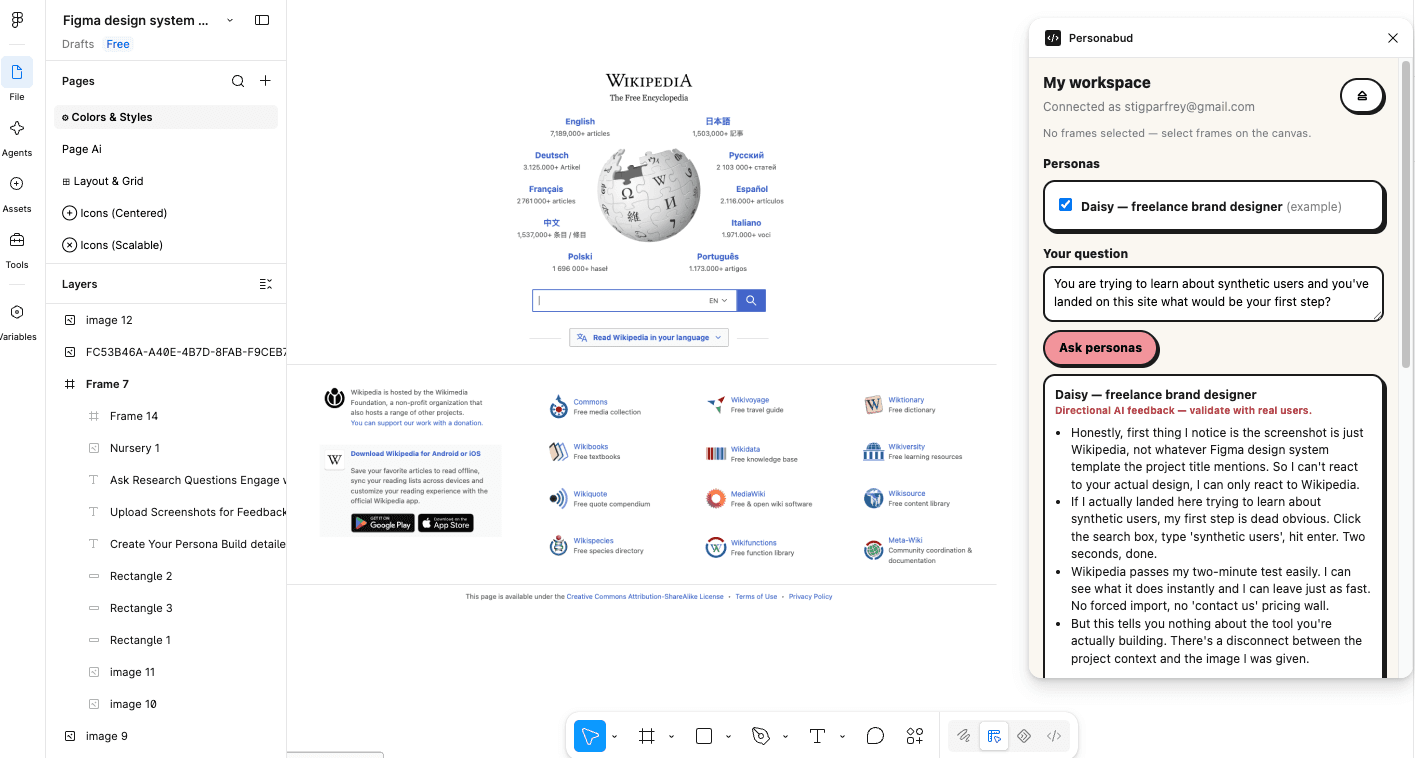
Personabud, right inside Figma
Select frames on your canvas, ask your personas, and read their directional feedback without leaving Figma. Same personas, built from your research. In private testing now, and headed for the Figma Community.
It doesn’t replace real users. That’s the point
Personabud pilots and prioritizes. It tells you where to point your real research budget, not how to skip spending it. Every report is labelled directional and ends with suggestions for what’s worth validating with real users.
Try Personabud today
The beta is open: create an account and start piloting with free starter credits. Or sign up to find out more as it grows.
Anything you upload stays private, is never used to train AI models, and can be deleted anytime.
Try the open beta